


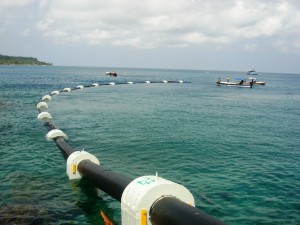
OUTFALL SAN ANDRES ISLAND – COLOMBIA
An outfall is a pipeline for wastewater discharges of urban or industrial origin in the sea some distance from the coast. The main objective of the outfalls is to minimize the potential impact of the discharge of sewage into the sea, or what is the same, ensuring good dilution so that the mixture of wastewater and seawater does not alter in any way the natural look and is harmless to the marine ecosystem, to the coast and to the health of humans.
There is a clear objective when you install an outfall: adequate primary and secondary dilution:
The primary dilution is obtained when the flow injected into the water depth is ascending to the surface due to density differences. To achieve good primary dilution the following factors must be taken into account:
- The depth of the injection: In general, the deeper the injection, dilution will get better, because it will increase the contact time between the effluent and seawater. However, the economic costs and construction difficulties increase with depth, so you should look for the best depth-cost ratio.
- The shape of the outlet of the outfall: The circular morphology is recommended because it has a good spread and minimizes the accumulation of sediment, which prevents clogging.
- The orientation of the jet incident: With a horizontal orientation higher effluent path is achieved, so it is recommended that the vertical orientation, which leads directly to the surface.
- Undercurrents: The presence in the injection of permanent or semi-permanent currents can positively influence the path of the effluent, getting a better dilution. It is highly recommended to make a thorough study of the currents before the construction of an outfall.
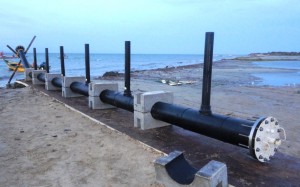
OUTFALL- MARGARITA ISLAND – VENEZUELA
The secondary dilution or dilution drag is created by the wind currents generated in the surface layers of water. This type of dilution depends almost entirely on the properties of the current, so that the factors to consider are:
- The wind direction and intensity: It is important to study the statistical data on the intensity and direction of winds usually found in the area.
- The morphology of the coast and seabed: Topographic features such as cliffs, coves, …, influence the winds and the presence of a bar, an elevation of the seabed along the coast, can become an obstacle preventing the dispersion of the stain.
- The tides and waves: Equally important is to study the tides and wave dynamics, to know how they can impact on the area where the secondary dilution is made.
SOURCE: Varinia López Penalonga © 2012 – conCIENCIAtec